
TL;DR:
This article explores how gRPC works in Java and how it's used to implement distributed leader election. We'll cover the fundamentals of both technologies and see how they work together to create robust distributed systems.
Understanding Java gRPC and Distributed Leader Election
Part 1: Java gRPC - Modern Inter-Service Communication
What is gRPC?
gRPC (Google Remote Procedure Call) is a modern, open-source framework for building distributed applications and services. Unlike traditional REST APIs that typically use JSON over HTTP/1.1, gRPC uses Protocol Buffers (protobuf) as its interface definition language and HTTP/2 as its transport protocol.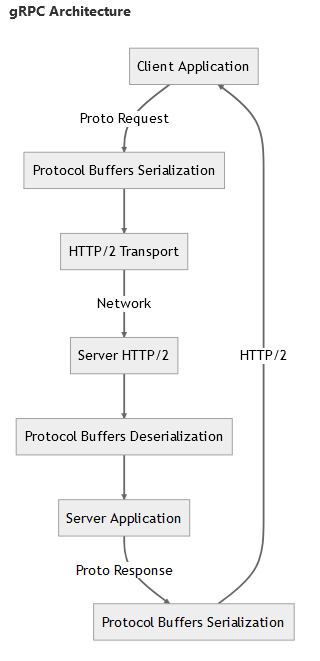
Key Features of gRPC
- Protocol Buffers: A language-agnostic mechanism for serializing structured data
- HTTP/2: Supports multiplexing, bidirectional streaming, and header compression
- Strong Typing: Interface contracts are strictly defined in .proto files
- Code Generation: Automatic generation of client and server code
How gRPC Works in Java
In Java, gRPC integration involves several components working together:
1.) Starting Point: .proto File
This is where everything begins - the service definition file; written in Protocol Buffers language syntax; defines services, methods, and message types as well as acts as the contract between client and server.
2.) Code Generation Process
The protoc compiler reads the .proto file; uses the gRPC Java plugin to generate code, creates multiple Java classes for both client and server sides as well as generates serialization/deserialization code automatically.
3.) Generated Components
Creates Client Stub classes for making RPC calls; generates Server base classes for implementing services; produces message classes for request/response types as well as all generated code will be type-safe and efficient.
4.) Runtime Communication
Client uses Stub to make remote calls; gRPC channel manages the network communication; server implementation handles incoming requests as well as all communication will be using HTTP/2 protocol.
Key Components in Action:
1. Protocol Buffer Definition Example:
syntax = "proto3";

service GreeterService {
 rpc SayHello (HelloRequest) returns (HelloResponse);
}

message HelloRequest {
 string name = 1;
}
2. Generated Client Stub Usage:
GreeterServiceStub stub = GreeterServiceGrpc.newStub(channel);
HelloRequest request = HelloRequest.newBuilder()
 .setName("World")
 .build();
stub.sayHello(request, responseObserver);
3. Server Implementation:
public class GreeterImpl extends GreeterServiceImplBase {
 @Override
 public void sayHello(HelloRequest request,
 StreamObserver responseObserver) {
 // Handle request and send response
 }
}
Type Safety: All generated code is statically typed
Performance: Uses efficient binary serialization
Streaming: Supports unary, server, client, and bidirectional streaming
Language Agnostic: Same .proto file works across different languages
Modern Protocol: Uses HTTP/2 for improved performance
Some Implementation Considerations:
Channel Management:
Channels should be reused when possible; proper shutdown handling is important and load balancing can be configured at channel level.
Error Handling:
Use proper error status codes; implement retry logic when necessary and handles deadline exceeded scenarios.
Performance Optimization:
Configure appropriate message sizes; use streaming for large data sets and implements proper connection pooling.
Part 2: Distributed Leader Election
Understanding Leader Election
Leader election is a fundamental problem in distributed systems where multiple nodes need to select a single node as the coordinator or leader. This leader typically manages critical operations and maintains system consistency.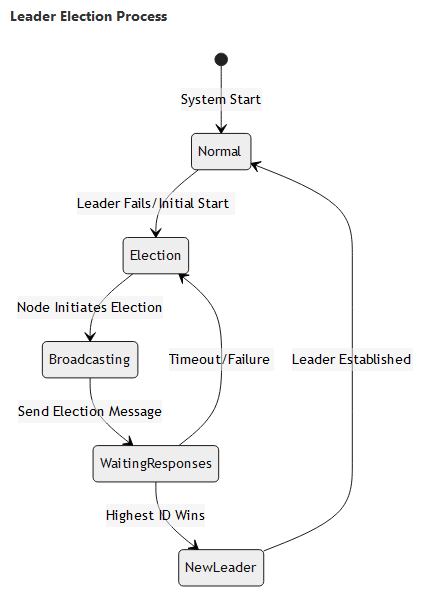
The Bully Algorithm
Our implementation uses the Bully Algorithm for leader election (There are also other Algorithms and I employ you to EXPLORE!!) . This algorithm gets its name because higher-numbered processes can "bully" lower-numbered ones by taking over as leader.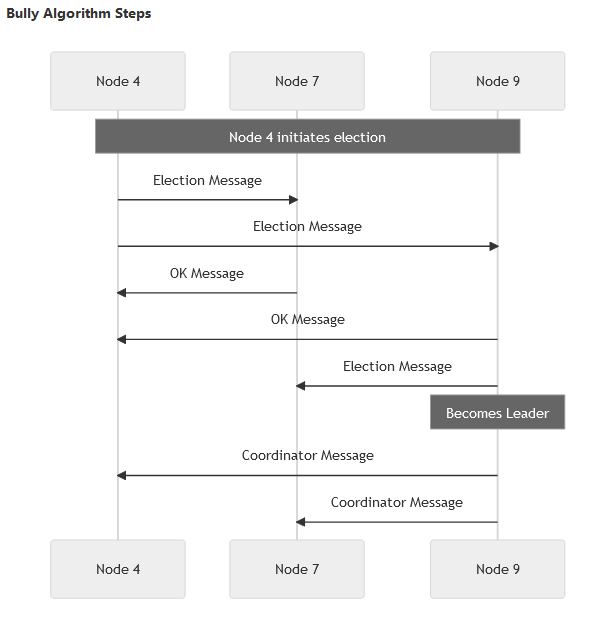
1.) Initial State
We have three nodes in the system: Node 4, Node 7, and Node 9. The numbers represent each node's ID (higher number = higher priority).
2.) Election Initiation
Node 4 detects that a leader election is needed (perhaps the old leader failed). Node 4 sends "Election" messages to all nodes with higher IDs (Node 7 and Node 9).
3.) Response Phase
Both Node 7 and Node 9 respond with "OK" messages to Node 4. This tells Node 4: "Back off, we have higher IDs than you" Node 4 now becomes inactive in the election.
4.) Higher ID Takes Over
Node 9, having the highest ID, sends an election message to Node 7. Since Node 9 has the highest ID, it doesn't need to wait for responses.
5.) Leader Declaration
Node 9 declares itself as the leader. It sends "Coordinator" messages to all other nodes (Node 4 and Node 7). This informs everyone in the system who the new leader is.
Key Properties of the Bully Algorithm to be Aware of:
Priority by ID: The node with the highest ID always wins the election
Bullying Behavior: Higher-numbered nodes take control from lower-numbered nodes
Multiple Elections: Several nodes might start an election simultaneously
Eventual Consistency: The system eventually stabilizes with the highest-numbered active node as leader
Some Implementation Considerations:
Timeout Handling: The system must handle cases where nodes don't respond in time
Message Types: Three types of messages are used:
Election: "I want to be the leader"
OK: "I have a higher ID, back off"
Coordinator: "I am the new leader"
Fault Tolerance: The algorithm can handle node failures during the election process
Example Implementation in Our System:
@Override
public void startElection(ElectionRequest request, StreamObserver responseObserver) {
 int nodeId = request.getNodeId();
 System.out.println("Election initiated by Node: " + nodeId);

 // If the nodeId received is greater than the highestId currently stored,
 // update the highestId
 if (nodeId > highestId) {
 highestId = nodeId;
 }

 // Send back the current max ID to the starting node
 ElectionResponse response = ElectionResponse.newBuilder()
 .setMaxId(highestId)
 .setStatus("Election in progress")
 .build();
 responseObserver.onNext(response);
 responseObserver.onCompleted();
}
My Implementation
Our implementation combines gRPC with the Bully Algorithm through several key components.
Notable Features Include:
a.) Peer registration with custom node IDs, addresses, and ports
b.) Dynamic leader election process
c.) Coordinator declaration after election completion
d.) List management of registered peers
e.) Fault-tolerant design for distributed systems
System Architecture:
The system is built using the following components:
1.) Protocol Buffers (leader_election.proto)
Defines the service interfaces and message types
Two main services: LeaderElectionand PeerRegstration
2.) Server ComponentsLeaderElectionServer: Main server implementationLeaderElectionServiceImpl: Handles election logicPeerRegistrationServiceImpl: Manages peer registration
3.) Client ComponentLeaderElectionClient: Provides methods for interacting with the server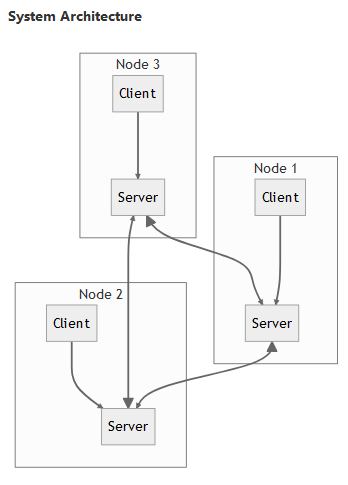
Implementation Details:
Leader Election Service
TheLeaderElectionServiceImpl class manages the election process:
i.) Tracks the highest node ID seen during elections
ii.) Maintains the current leader ID
iii.) Handles election requests and coordinator declarations
Peer Registration Service
The PeerRegistrationServiceImpl class handles:
i.) Registration of new peers
ii.) Maintenance of peer list
iii.) Retrieval of registered peers
>>>> For a more detailed look at the Implementation, Please visit my GitHub Repo
Conclusion
The combination of gRPC and distributed leader election provides a robust foundation for building distributed systems. gRPC's efficient communication protocol and the Bully Algorithm's straightforward approach to leader election create a system that is both performant and reliable.
Key Takeaways:
- gRPC provides efficient, type-safe communication between distributed services
- Protocol Buffers offer a language-agnostic way to define service contracts
- The Bully Algorithm provides a practical approach to leader election
- Combining these technologies creates a robust distributed system